

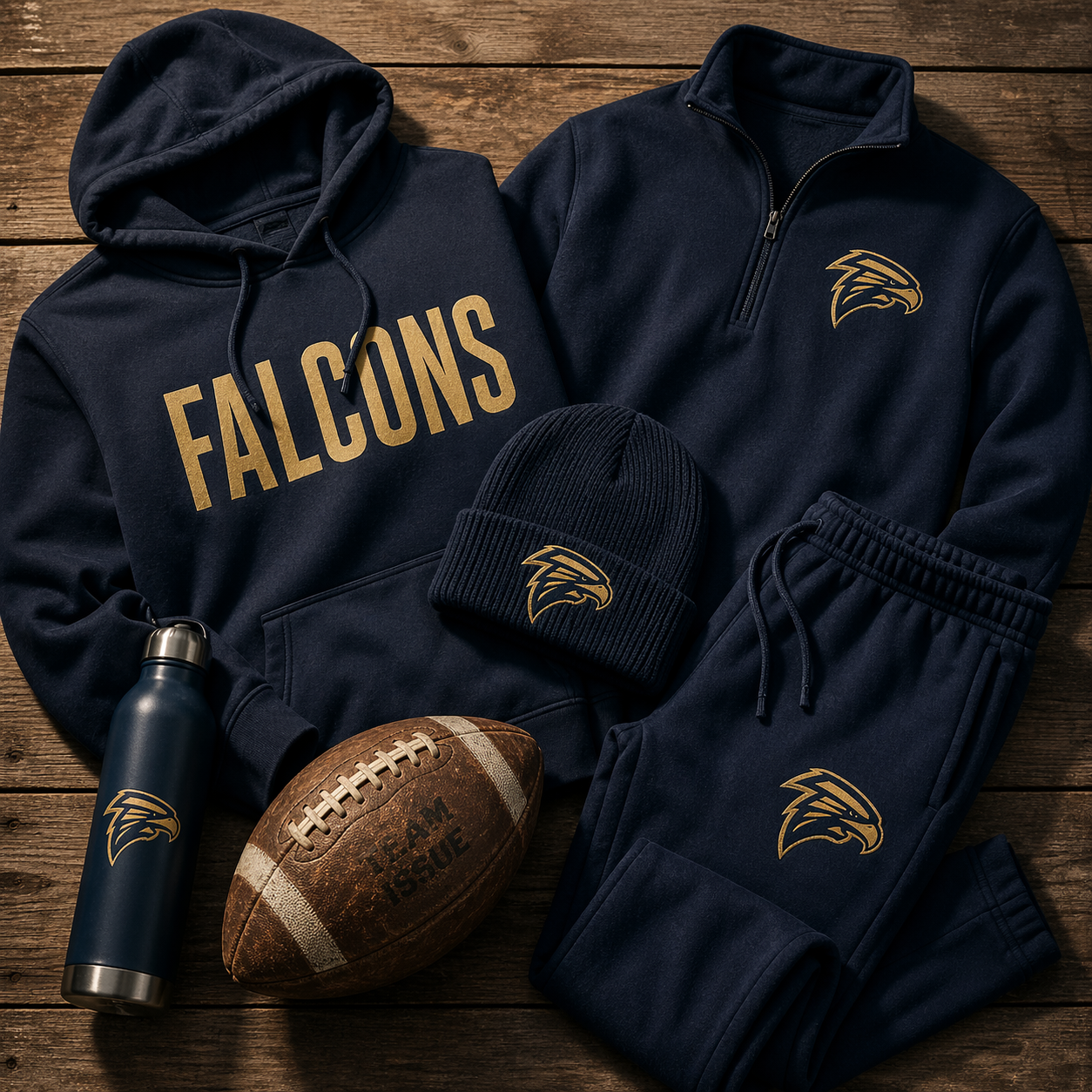
Decorationmethods, explained.
Screen print, embroidery, tackle twill, and sublimation. How each method works, what it costs, and when to use it.
Pick a custom football jersey off a senior's back in year three. Check the numbers. If they are cracking, the program picked screen print when it should have picked tackle twill or sublimation. If they are perfect, somebody made a decision about decoration method that paid off.
Decoration method is the variable that determines how your team gear ages. It is also one of the last things most coaches think about when placing an order, because most programs let the vendor pick.
This guide walks through the four main team apparel decoration methods: screen print, embroidery, tackle twill, and sublimation. What each one does. What each one costs. What each one holds up to. Which one fits your program's gear list.
The four decoration methods at a glance.
Screen print. Ink pushed through a mesh screen onto fabric. Fastest and cheapest at volume. Best for practice gear, spirit wear, and numbered items at scale. Can crack over time on stretched or heavily washed garments.
Embroidery. Thread stitched into fabric by machine. Priced per stitch. Most durable of the four. Best for polos, hats, jackets, and anything that needs a tactile, logo-forward finish.
Tackle twill. Fabric letters and numbers cut and sewn onto a base garment. The traditional jersey aesthetic. Used on most football and baseball game jerseys. Premium feel, labor-intensive, higher cost.
Sublimation. Dye infused into polyester fabric using heat and pressure. The design becomes part of the fiber. Best for full-custom designs with all-over patterns or bright multi-color graphics. Cannot crack or peel.
Most real game-day jerseys combine two or more of these methods. A football jersey often runs a sublimated body with tackle twill numbers. A coach's polo often pairs embroidery on the chest with a screen-printed sleeve logo. Understanding each method is step one. Knowing how they combine is step two.
Screen printing.
Screen printing is the fastest and most affordable decoration method, and it covers most gear that is not the game jersey. Practice tees, spirit wear, numbered items at scale, warm-ups, and team store basics typically run screen print.
Here is how it works. A design is burned onto a mesh screen, one screen per ink color. The screen gets laid over the garment, ink gets pushed through with a squeegee, and the garment runs through a cure oven to set the ink. At scale, the process moves fast. Twelve-color designs are possible but uncommon. Most screen print designs run three to five colors to keep cost and setup time manageable.
Cost is the low end. Per-unit cost drops fast as order quantity goes up because setup is the fixed part of the job. Twelve shirts cost almost the same to set up as two hundred, so the per-shirt number on a bigger order looks much better.
Durability depends on the ink and the garment. Plastisol ink (the thick, slightly raised kind) is the workhorse and handles normal wear well. Water-based and discharge inks feel softer and wash better but cost more. Screen print can crack over time on garments that stretch heavily or go through high-heat dryers repeatedly. If you have an old team t-shirt where the letters are crazed and flaking, you are looking at screen print that aged out.
Lead time is the shortest of the four methods. Screen-printed orders typically run one to three weeks once proofs are approved.
When to skip it: full-color photo-style designs, all-over patterns, and any design where the ink weight would change the feel of the garment. Sublimation is the better call for those.
Embroidery.
Embroidery is the most durable of the four decoration methods, and the most premium-feeling. It is the right call on coaching polos, jackets, hats, and anything that needs a tactile, logo-forward finish.
Here is how it works. A digital design is converted into a stitch file (called digitizing) that tells the embroidery machine where every needle drop goes. The machine sews thread directly into the fabric, building the design out of stitches. Modern multi-head embroidery machines can run twelve or fifteen pieces at once with thread color changes managed automatically.
Cost scales with stitch count, not piece count. A small left-chest logo on a polo (around 5,000 stitches) is inexpensive at any volume. A back-yoke embroidered crest (50,000+ stitches) costs meaningfully more per piece because the machine is running for longer. The first-time digitizing fee is usually a one-time charge that lives across reorders forever.
Durability is the strongest of the four. Embroidered logos do not crack, peel, or fade. The stitches are part of the fabric, not on top of it. The only failure mode is a thread snag from rough wear (a backpack strap or a velcro patch), and even then the design holds up better than any other method.
Lead time is moderate. Once digitizing is done, embroidered orders typically run two to four weeks. The longest variable is hat or jacket production at the apparel manufacturer level, not the embroidery itself.
When to skip it: game jerseys (the stitch density adds weight that affects fabric drape during play), large body designs (cost scales fast at high stitch counts), and any design with thin lines or gradients (embroidery cannot render either cleanly). Tackle twill or sublimation is the better call for game-day uniforms.
Tackle twill.
Tackle twill is the traditional jersey decoration method. Fabric letters and numbers cut to shape, then sewn directly onto the base garment. It is the spec on most football and baseball game jerseys at the varsity level, and the visual standard for any program that wants the classic team-uniform look.
Here is how it works. Letters and numbers get cut from a separate fabric (typically a polyester twill weave) using a heat cutter or die-cut press. The pieces get positioned on the jersey, heat-sealed in place to hold them during sewing, and then stitched around the perimeter on a programmable sewing machine. Some programs go a step further with double-layer twill (a colored letter on top of a contrasting outline letter) for a varsity-letter aesthetic.
Cost is the highest of the four methods. Each letter and number is a separate piece of fabric that has to be cut, positioned, and sewn. A football jersey with a chest letter, sleeve number, and back number can run twenty to thirty separate twill pieces. The labor adds up. At volume, the per-jersey cost still lands in a normal range, but tackle twill is never the cheap option.
Durability is excellent for the right product. Tackle twill survives a four-year senior class on a jersey that gets washed weekly through a season. The fabric pieces age at the same rate as the base garment, which is why a tackle twill football jersey from year one still looks like the right uniform in year three. The failure mode is corner lift on a poorly-sewn perimeter, which a quality production partner controls for.
Lead time is the longest of the four methods. Tackle twill orders typically run four to six weeks once proofs are approved, because the cut-and-sew process is labor-intensive and runs at a fixed throughput per machine.
When to skip it: basketball, soccer, lacrosse, and volleyball jerseys (the panel weight affects how the fabric stretches during play), spirit wear and practice tees (cost is wrong for the use case), and any design with thin lines or non-standard shapes (twill cuts cleanly only on closed shapes). Full sublimation is the right call for those.
Sublimation.
Sublimation is the modern decoration method that lets a jersey be fully customized end to end. Numbers, names, panel work, body color, sleeve detail, inner-collar prints all dye into the fabric in one pass. It is the spec on most basketball, soccer, lacrosse, and volleyball game jerseys today.
Here is how it works. The jersey design is printed onto a special transfer paper using sublimation inks. The printed paper gets laid against a piece of polyester fabric and run through a heat press at around 400 degrees. The heat turns the ink into gas, which bonds with the polyester at the molecular level. The result is a design that is part of the fiber, not a layer on top of it. Sublimation only works on polyester or polyester-blend fabrics; it cannot be done on cotton.
Cost is moderate. Sublimation runs at a fixed cost per piece regardless of design complexity, which is the unique advantage of the method. A jersey with a single-color body and white numbers costs the same to sublimate as a jersey with full panel work, custom inner-collar prints, and a dye-color gradient. Setup is digital, so there is no per-color upcharge like there is on screen printing.
Durability is excellent because the design is in the fabric, not on top of it. Sublimation does not crack, peel, or fade. The only way a sublimation jersey loses its look is if the fabric itself wears out, which on a high-quality polyester game jersey takes years of heavy use. Color saturation is the highest of any method, which is why championship jerseys and college uniforms typically run sublimation.
Lead time is moderate. Sublimation orders typically run three to five weeks once proofs are approved. The bottleneck is the heat-press capacity of the production partner, not the design or art prep.
When to skip it: cotton or cotton-blend garments (sublimation does not work on cotton), white or light-colored designs on dark fabric (sublimation only adds color, it does not subtract; you cannot sublimate a white logo onto a black shirt), traditional baseball aesthetics (tackle twill is the better look), and small left-chest logos on polos or jackets (embroidery is the right tactile fit). For most modern team-sport game jerseys, sublimation is the default.
How they combine on a real uniform.
Most varsity-level uniforms use two or more methods together. The combinations are not arbitrary; each one solves a specific problem.
Football jersey: tackle twill numbers and names on a sublimated body. The twill gives the jersey the visual weight of a real football uniform; the sublimation handles the side panels and color blocking that screen print or twill cannot do cleanly.
Coaching polo: embroidered chest logo with a screen-printed sleeve mark. The chest carries the program identity in a tactile finish; the sleeve handles the program tagline or sponsor mark at lower cost.
Basketball jersey: full sublimation, end to end. The single-method approach keeps the fabric weight consistent, the color saturation high, and the design holding up to heavy laundering across a season.
Spirit wear t-shirt: screen print, three to five colors, on a cotton or 50/50 blend. Cheap to produce at volume, durable enough for daily wear.
Decoration method is not a marketing decision. It is a structural decision about how a uniform ages. Pick wrong, and the jerseys crack at year two. Pick right, and a four-year senior class wears the same look from freshman year to graduation.
More on the same shelf.
- Apr 14, 2026 · Kevin Badke · 7 min
Why local matters.
Why Virginia athletic programs get more from a local team apparel partner than a national vendor.
- Apr 16, 2026 · Scott Reinen · 7 min
Choose a partner without getting burned.
How to vet a custom apparel partner, what to ask, and the red flags that signal a vendor will burn your season.
- Apr 20, 2026 · Kevin Badke · 8 min
How to order team uniforms.
How the custom team uniform ordering process works, with timelines that will not burn your season.
Start the
conversation
Three fields, fifteen minutes. We come back with a scoped quote inside 48 hours, not a catalog and a sales rep.